
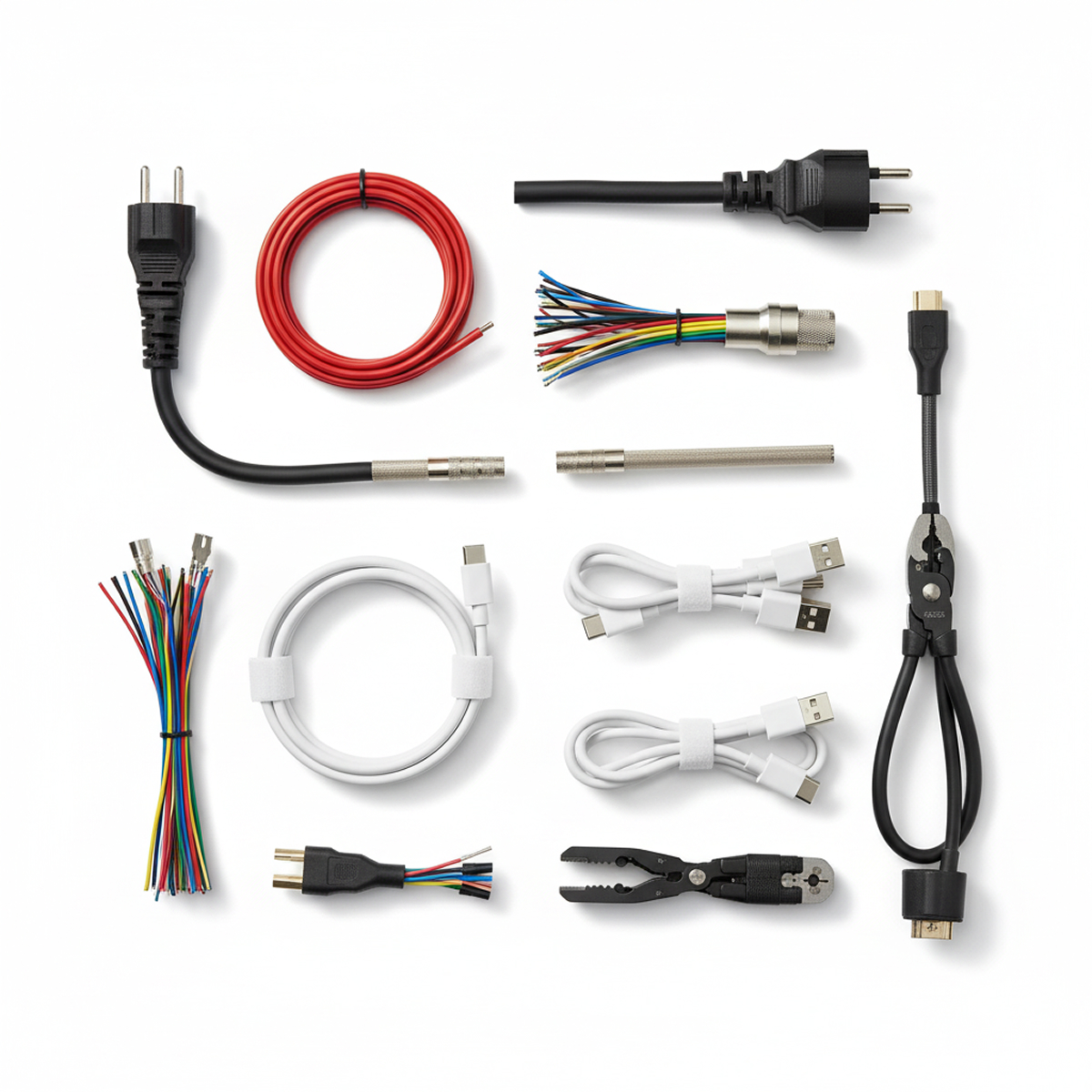
Description
Cables and wires are fundamental components of electrical systems, carrying power and signals. While there are countless variations, they can be broadly categorized into several basic types based on their construction, application, and conductor material. Here’s a breakdown of the basic types of cables and wires:
I. Based on Conductor Material
- Copper Cables/Wires
- Most common and versatile.
- Excellent conductivity
Carries electrical current efficiently. - Malleable and ductile
Easy to bend, shape, and terminate. - Corrosion resistant
More durable in various environments. - Applications
Power transmission and distribution, electronics, telecommunications, building wiring, automotive, appliance cords.
- Aluminum Cables/Wires
- Lighter and cheaper than copper.
- Good conductivity, though less than copper.
- Prone to oxidation
Requires special connectors to prevent corrosion and ensure good contact. - Applications
High-voltage power transmission lines (due to weight and cost advantages), larger gauge feeders in buildings, some overhead service drops.
- Steel Cables/Wires
- High tensile strength
Primarily used for mechanical support rather than current carrying. - Often coated with zinc (galvanized) or other materials for corrosion resistance.
- Applications Guy wires for poles, messenger wires for overhead cables, grounding wires (sometimes in conjunction with copper), structural support in some specialized applications.
- High tensile strength
Understanding these basic types is crucial for selecting the correct cable or wire for any given electrical application, ensuring safety, reliability, and optimal performance.


Reviews
There are no reviews yet.